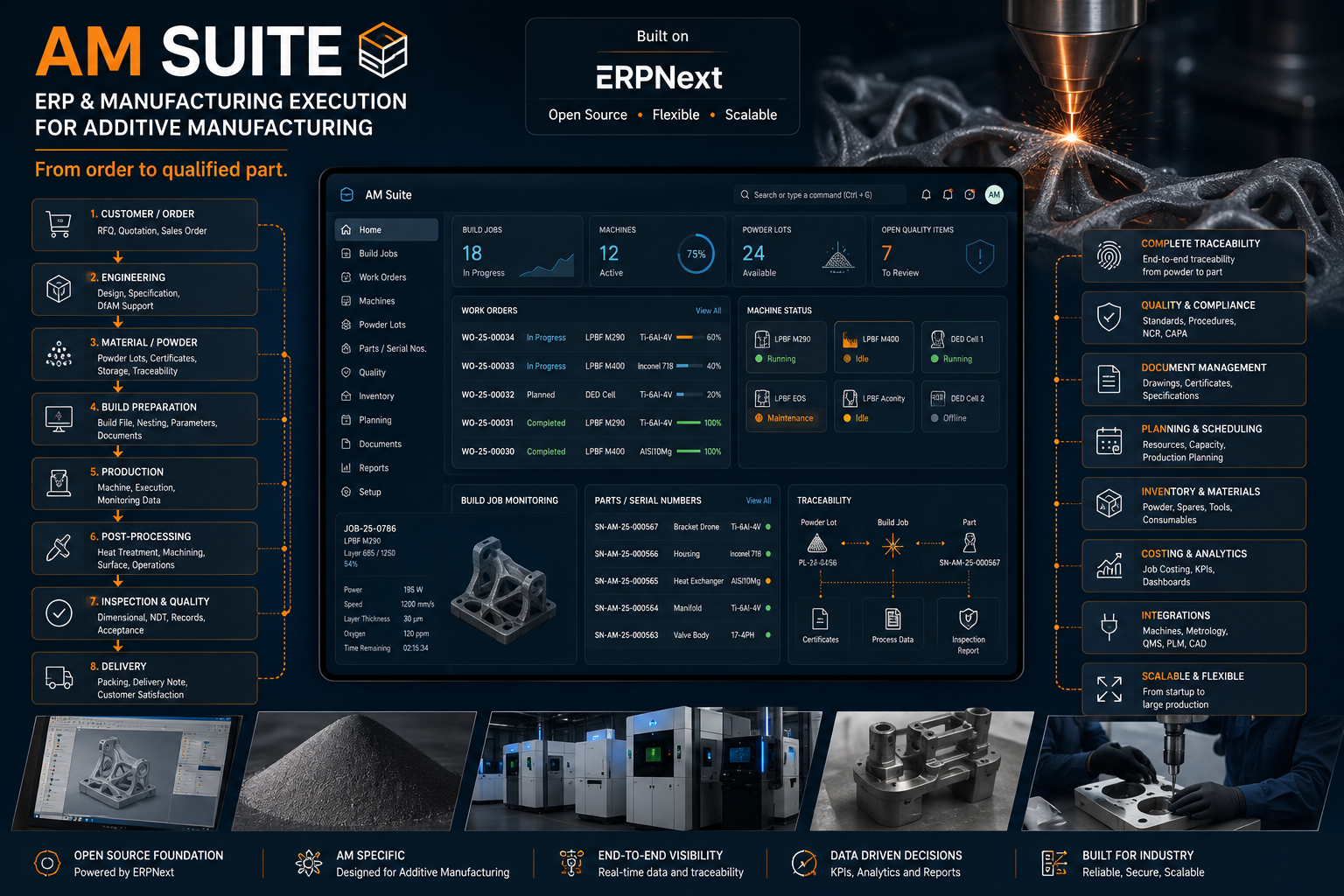
AM ERP is a personal development based on ERPNext. The idea was simple: use an existing open-source ERP as a baseline and add what is missing for Additive Manufacturing production, traceability and qualification.
For me, industrialising Additive Manufacturing is not only about finding good parameters or producing a good part. At some point, the real problem becomes how to manage the process, the material, the builds, the qualification status and all the information around them.
Why I started this project
During development, Excel works quite well.
You have a machine, some builds, a few powders, process parameters, mechanical results and maybe a shared folder containing the reports. For R&D, this is often enough.
The problem starts when the same activity moves towards production.
Then a part is not only linked to a parameter set. It is also linked to a material batch, powder history, a machine, a build file, a machine configuration, post-processing operations, inspections, deviations, qualification records and finally a release decision.
Most of this information already exists. The problem is that it is usually distributed between Excel files, folders, machine software, PDFs and sometimes an ERP.
The difficult part is not collecting more data. It is keeping the links between the data.
Why ERPNext?
I did not want to develop an ERP.
There would be little interest in rewriting purchasing, inventory, customers, sales orders, bills of materials, manufacturing orders, serial numbers, batch management, assets, users or permissions.
These functions already exist in ERPNext, the open-source ERP from the Frappe ecosystem.
ERPNext therefore provides the baseline.
The objective of AM ERP Suite is to add the objects and relationships which are more specific to Additive Manufacturing.
Do not rebuild what already exists. Keep ERPNext for the conventional ERP functions and add the AM-specific layer on top of it.
Powder is not just stock
This is one of the first differences with a conventional ERP.
For Additive Manufacturing, knowing that 40 kg of Ti64 are available in inventory is not enough.
I may also need to know the powder batch, the material certificate, the applicable specification, the incoming inspection results, the storage conditions, previous use, blending or refresh history and which builds consumed this powder.
The powder history therefore becomes part of the manufacturing genealogy.
This becomes particularly important when a process is qualified with defined material conditions or powder reuse rules.
A build as a manufacturing object
The build is another object which is not naturally represented in a generic ERP.
A build is not only a file sent to the machine.
It connects together the machine, the material, the powder batches, the parts, serial numbers, the parameter set, the build file, machine configuration, operators, process information and the following manufacturing steps.
Machine → powder → parameter set → build → part → post-processing → inspection → release
Once this relationship exists, traceability can work in both directions.
I can start from a serialised part and reconstruct its manufacturing history.
But I can also start from a powder batch, a machine, a parameter revision or a deviation and identify which parts may be affected.
Post-processing is part of the process
For metal Additive Manufacturing, the manufacturing process does not stop when the machine finishes the build.
Stress relief, HIP, support removal, machining, surface finishing, cleaning and inspection may all be part of the manufacturing route.
For qualified production, these operations cannot really be followed as independent activities.
They belong to the same manufacturing history.
The interest of an integrated system is therefore not only to store these operations, but to keep their relationship with the part, the build and the qualification state.
Qualification is probably the most interesting part
This is also where I think a conventional ERP becomes insufficient.
Traceability tells me:
How was this part manufactured?
Qualification should answer another question:
Was this part manufactured inside an approved manufacturing state?
These are not the same question.
Machine qualification
A build should not only reference a machine number.
The useful question is whether the machine was in the correct configuration and qualification state when the build was produced.
Calibration, maintenance, capability checks and machine configuration may therefore need to remain connected to production.
For me, this is important because the qualification belongs to a manufacturing state, not simply to the physical machine.
Material qualification
The same applies to the material.
A powder can exist in inventory without being approved for a specific production process.
The software therefore needs to distinguish between material availability, material conformity and material approval for a qualified process.
This difference is small from an ERP point of view, but important from a manufacturing point of view.
Process qualification
A qualified AM process is not simply laser power and scan speed.
Depending on the application, the qualified state may include machine type, material, parameter set, layer thickness, scan strategy, orientation, geometry range, heat treatment, post-processing, inspection requirements and acceptance criteria.
I therefore prefer to think in terms of a qualification envelope rather than a list of individual parameters.
Material A + Machine B + Parameter Set C + Layer Thickness D + Heat Treatment E
This combination can represent one approved manufacturing state.
If one element changes, the question becomes:
Is the qualification still valid?
Sometimes yes.
Sometimes an engineering review is sufficient.
Sometimes additional testing or requalification is required.
Part qualification
Finally, the part itself has requirements.
Drawings, specifications, inspection plans, test results and acceptance criteria need to remain connected to the qualified process and to the actual production record.
Requirement → Qualified process → Production → Inspection → Release
For me, this chain is more useful than treating qualification as a separate PDF report stored somewhere on a server.
Changes and requalification
A qualification is useful only if changes are controlled.
A new powder specification, a machine modification, a different heat-treatment cycle or a revised parameter set may affect existing qualifications.
This is another area where I see an interest in connecting qualification directly to manufacturing data.
When something changes, the system should help answer simple questions:
Which processes use this parameter set?
Which parts use this material specification?
Which builds were produced on this machine?
Which qualifications may be affected?
Is an engineering review needed?
Is additional testing required?
Is requalification necessary?
This is, in my view, where the link between ERP, MES and qualification starts to become really useful.
ERP, MES, QMS?
I am not sure AM ERP Suite needs to fit perfectly into one category.
ERP
What was ordered?
What is in stock?
What needs to be produced?
What does it cost?
MES
What is being produced?
On which machine?
With which parameters?
Was the manufacturing route completed?
Quality and qualification
Was the correct process used?
Was it qualified?
Were the required inspections completed?
Can the part be released?
For Additive Manufacturing, these questions are strongly connected.
This is why I see AM ERP Suite more as an AM manufacturing information backbone than as a pure ERP or a pure MES.
What about process data?
AM machines can generate large quantities of data.
I do not think that every monitoring image, sensor signal or machine log needs to be stored directly inside the ERP database.
The ERP/MES layer mainly needs to know the context.
Which part? Which build? Which machine? Which powder? Which parameter set? Which qualification state?
The detailed technical data can remain in a dedicated database or file storage as long as the relationship with the manufacturing record is maintained.
For me, this separation is important.
The objective is not to make ERPNext a data lake.
The objective is to use it to keep the manufacturing context around the data.
Why this could be useful for an SME
The main interest for an SME is probably not to have more software.
It is to avoid reaching the point where production depends on twenty Excel files, individual knowledge and a directory structure that only one person really understands.
At the same time, deploying a large commercial ERP, MES and QMS environment may be difficult to justify for a company operating only a few AM machines.
An open-source baseline creates another possibility.
The company can start with a relatively simple system and add functions when they become necessary.
Development
Experimental builds, a few machines, process data and basic material tracking.
Pre-production
Formal build records, controlled parameter sets, manufacturing routes, work instructions and inspection.
Qualification
Machine, material and process qualification, approved baselines and acceptance criteria.
Qualified production
Serialised parts, complete genealogy, quality records and verification against the qualified manufacturing state.
Industrial operation
Planning, inventory, costing, KPIs, change control and automated data exchange.
There is no need to design the final system on day one.
It can grow with the manufacturing activity.
For an SME, I think this progressive approach can make more sense than deploying a complex manufacturing IT environment before the production system itself is mature.
More an engineering exercise than an IT project
This is actually the part of the project that I find the most interesting.
What information is really needed to industrialise Additive Manufacturing?
Writing the software forces me to answer questions which are easy to leave vague during normal development work:
What exactly is a build?
What defines a qualified process?
What is the relationship between a parameter set and its qualification?
How should powder genealogy be represented?
Which variables really define the qualified state?
What information needs to follow a serialised part?
Which changes are important enough to trigger review or requalification?
Where does development stop and production control start?
These look like database questions.
In reality, most of them are manufacturing engineering questions.
Where it could go
AM ERP Suite is still a development project, not a commercial product.
There are many possible extensions: machine interfaces, automatic collection of production data, statistical process control, qualification management, monitoring data, material databases, automatic checks against qualification envelopes and links with engineering analysis tools.
I do not intend to reproduce every function of a large commercial manufacturing platform.
The question I want to explore is simpler:
Can a relatively simple open-source ERP/MES architecture provide enough structure, traceability and qualification control for a small Additive Manufacturing organisation?
For me, the final objective is not only to know how a part was produced.
It is to be able to show that it was produced with the right material, on the right machine, with the right process and inside the correct qualification state, and to keep the evidence needed to demonstrate it.
Extending the system with engineering rules
Another reason I chose this approach is that the system does not have to remain limited to standard ERP functions.
Specific engineering or manufacturing rules can be added relatively easily using Python.
For example, the system can check whether a powder batch is still authorised for production, whether a machine is inside its qualification period, whether a parameter set is approved for a particular material, or whether a change requires an engineering review.
The same principle can be used to automate relatively simple decisions:
Is this material qualified for this process?
Is this machine available and qualified?
Can this powder batch still be reused?
Does this build configuration remain inside the qualification envelope?
Are all mandatory inspections completed before release?
For me, this is an important point.
The ERP does not only store the manufacturing information. It can also start to apply some of the manufacturing logic associated with that information.
From traceability to production management
The same data model can also be used to manage the work itself.
A Kanban board can provide a simple view of builds, parts or manufacturing tasks moving through the production flow.
For example:
To do → Build preparation → Printing → Heat treatment → Machining → Inspection → Release
For more complex projects or industrialisation activities, the same tasks can be represented through PERT or Gantt views in order to make dependencies, milestones and critical activities visible.
This becomes particularly interesting when several machines, furnaces, inspection systems or operators share the same production workload.
At that point, planning is no longer only a list of due dates.
It becomes a resource-allocation problem.
A scheduling module can use the information already available in the system:
machine availability,
machine qualification status,
build duration,
material compatibility,
post-processing capacity,
operator availability,
inspection capacity,
task dependencies,
delivery dates,
and production priorities.
Python can then be used to implement scheduling or optimisation rules which try to reduce delays, avoid resource conflicts or improve machine utilisation.
The objective does not have to be a sophisticated optimisation algorithm from the beginning.
A relatively simple scheduler can already answer useful questions:
Which build should be launched first?
Which machine should be used?
Will a heat-treatment resource become a bottleneck?
Can two orders share the same build?
What happens to the delivery date if one machine becomes unavailable?
Where is the current critical path?
This is where I see AM ERP Suite progressively moving from an ERP used to record manufacturing information towards a more complete manufacturing engineering and production-management environment.
The interesting point is that the planning, qualification and traceability functions are not independent.
The scheduler should not allocate a build to the first available machine if that machine is not qualified for the required process.
In the same way, a production task should not be considered complete simply because an operation has been performed if the corresponding inspection or qualification requirement is still missing.
For me, this connection between planning, resources, manufacturing rules, qualification and traceability is probably more useful than treating each of these functions as a separate software tool.
Categories:
Tags:
No responses yet